Best Surf Spots Near Tokyo: A Local's Guide
The surf spots within day-trip range of Tokyo fall into three areas — northern Chiba, southern Chiba, and Shonan. Here's what each one is like, who it suits, and when to go, from someone who's surfed them for 28 years.
How to think about surfing near Tokyo
Almost every surf spot within day-trip range of Tokyo is about 90 minutes out and is a beach break — forgiving, shifting with the sand, and good for all levels. The main reef exception is Kamakura; most other reefs are effectively secret or difficult for visitors. From first-timers to pros, everyone shares the same lineup, so knowing each spot's local etiquette matters.
One more thing worth knowing: these coastlines are long. Part of the fun is cruising along the coast and checking the waves as you go, rather than committing to one car park. That's also why going on a private surf day trip from Tokyo with someone who knows the area pays off — the best peak for your level on a given day moves around.
Northern Chiba
Open Pacific, the most consistent and powerful surf near Tokyo, and the coldest water of the three areas. It picks up east and southeast swell, and the wind tends to turn onshore (east/northeast) during the day, so mornings are often best.
Katakai
The closest Chiba beach to Tokyo. Mellow, easy-to-ride waves, and a big breakwater that blocks the wind — which means it's surfable on a lot of days when other spots aren't. Consistent, and genuinely fine for everyone from beginners to pros.
Ichinomiya
The main spot of the Ichinomiya area and the most famous stretch of coast here. Breakwaters keep the wind from wrecking it, so clean waves form easily. There are many breakwaters, and each one is its own differently-named peak with its own character. Beginner-friendly spots are limited here, but they do exist.
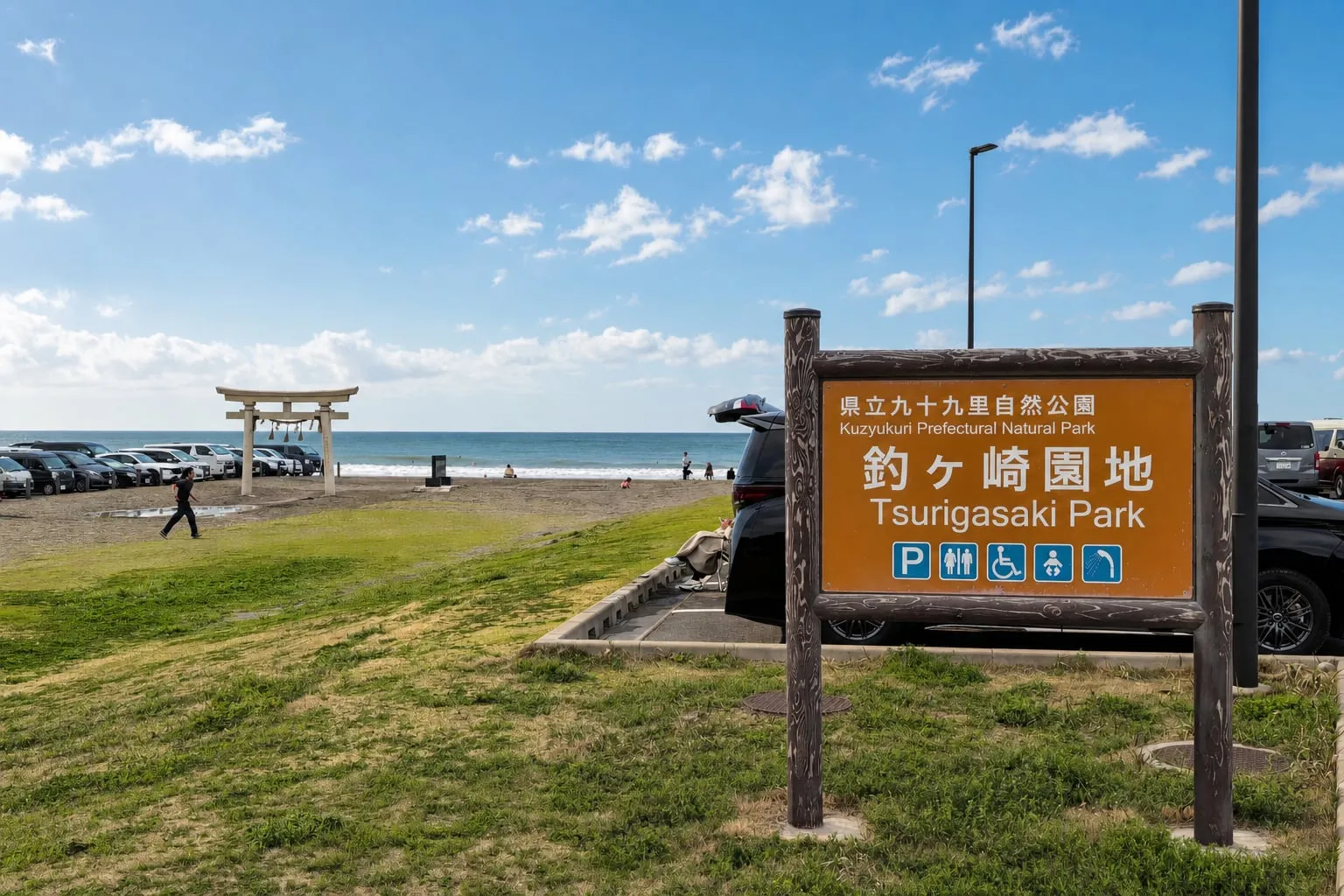
Shidashita (Tsurigasaki)
The Tokyo 2020 Olympic surfing venue — a hollow wave that's advanced-level, though intermediates can still enjoy it. It's also a surprisingly easy spot to spend a day: rare for the area, it has toilets, paid hot showers and free parking, plus a torii gate that gives it a distinctly Japanese feel. And right next door is beginner-friendly Taito — so a wide range of surfers can be happy on the same beach.
Taito
Usually a beginner-friendly beach, and a useful fallback: it stays surfable when other, more exposed spots are closed out by too much swell.
Iioka
Further north, and south-facing — so it picks up south swell and a north wind blows offshore here, the opposite of most spots nearby. Handy when the wind is wrong everywhere else.
Southern Chiba
Cleaner, warmer water than the north, thanks to the nearby Kuroshio current. The Tokyo Bay Aqua-Line roughly halved the drive from Tokyo, so the south is very doable as a day trip now.
Onjuku
A beginner-friendly beach that turns on with proper waves during typhoon swells.
Kamogawa
A surf town down in Minamiboso with a really good atmosphere and quality points — including longboard-friendly waves and beginner spots. Worth it as much for the town as the surf.
Southern Chiba also holds some excellent reefs, but those are expert-only.
Shonan
Shonan sits inside Sagami Bay, so the waves are smaller than Chiba but stay organized and tidy — even small days are very surfable. It's the easiest area to reach by train, which makes it popular and often crowded, and on a clear day you surf with Mt. Fuji on the horizon (yes, this is the view in Hokusai's famous wave).
The Fujisawa coast (Kugenuma to Chigasaki)
A long stretch of south-facing beach break that's surfable in many places, with Kugenuma and Chigasaki as the best-known. If you're going by train and on foot, Kugenuma is the most accessible. Clear days bring out Mt. Fuji, and this is the heart of Japan's beach culture.
Kamakura
The reef exception. It lights up beautifully when a swell comes in, and of the reefs around here it's the most open to visitors. You can surf right in front of the Enoden train as it rattles past — about as scenic as it gets.
My favorite
Shichirigahama in Kamakura when a typhoon is sending swell. From Inamuragasaki at one end to Kamakura-Kokomae (Kamakura High School) at the other, there are more than ten reef peaks, and during a typhoon it's a stunning sight.
And there's far more coast than any map shows. Beyond the locals-only secret spots, there are plenty of breaks anyone can surf. As with the long Fujisawa shoreline, northern Chiba's Kujukuri beach runs for miles — and checking the waves as you move along the coast is half the fun.
How far is each area from Tokyo?
All three areas work as a single day out from the city. Northern Chiba — Katakai, Ichinomiya, and the Olympic venue — is roughly a 90-minute drive. Southern Chiba (Onjuku, Kamogawa) is a little further, but the Tokyo Bay Aqua-Line cut the drive down enough that it's very doable now. Shonan is the closest and the only area that's genuinely easy to reach by train. Which one is best on a given day comes down to the swell and wind, not the distance — that's the call a surf day trip from Tokyo makes for you on the morning, after checking the forecast.
When to go, and crowds
Famous spots get crowded on weekends. Seasonally, Japan's surf scene wakes up around Golden Week (the early-May holidays), and the water gets busier from then on. Rain or cloud thins the crowd without hurting the wave quality — so a grey day can be a good day. The one hard no is lightning; we won't guide in a thunderstorm.
Water temperature splits by area. Northern Chiba is coldest (a 5mm wetsuit with boots in winter, around 3mm in spring and autumn, a spring suit or boardshorts in summer), while Shonan and southern Chiba run a notch milder. Near Tokyo a semi-dry suit is plenty year-round — you don't need a drysuit.
You don't have to memorize all this
That's the whole point of going on a guided surf day trip. On the day, we match the spot to your level and the conditions — including practical things like which beaches have toilets and showers. Beginners usually do best at Katakai, Taito, Onjuku, or Kugenuma; more experienced surfers get taken to whatever's firing. You just get in the water.
Ready to surf near Tokyo?
Private day trip from Tokyo · English-speaking guide · From ¥64,000 per person (2 surfers; ¥88,000 solo) · Free cancellation up to 24h.
Book on GetYourGuide